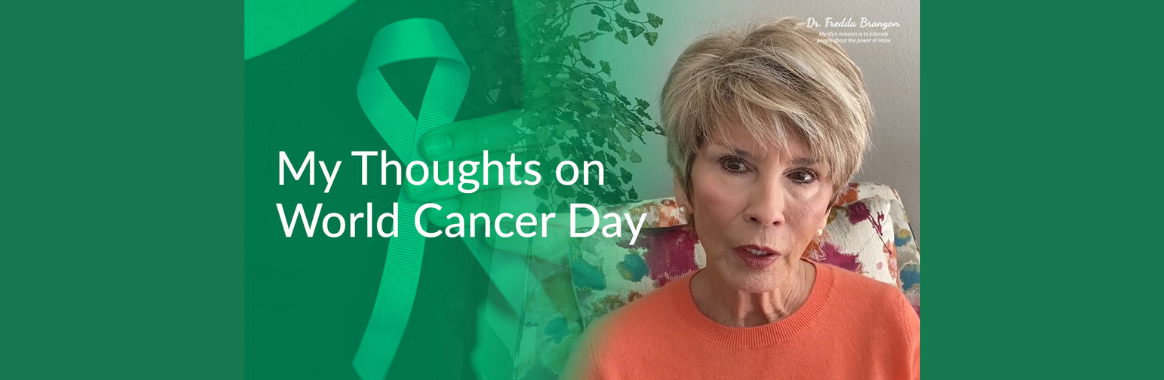
Hi, I’m Dr. Branyon with New Hope Unlimited. Today is February the 4th 2022. If you are not watching this video on today, that’s okay. Because whether it’s February, the 4th 2022 are three months down the road or a year down the road or two, five years down the road, my purpose in this video is going to be the same. So the reason I’m saying it’s February, the 4th 2022 is because today is considered the World Cancer Awareness Day. And I wanted to give you some numbers, so I’m going to be reading off my notes a little bit.
I try not to do that but this has got numbers, and I want to make sure I get the numbers correct and to give you the places that you can go to see the numbers for yourself so that you know, I’m not making them up because they are astronomical numbers. And that’s one of the reasons I’m going to be saying some of the stuff I’m saying today. Well it’s like, nowadays, here in the United States, when you hear about someone that’s diagnosed with cancer, it’s so commonplace that in our society, that’s like, well, so that’s a bad thing. I hope they do okay. Or, or it’s drastic, it’s terrible. Because it could be yourself. It could be your loved one, your child, could be a lot of things. But what I’m getting at is that it is such a commonplace now, in our society here in the United States, not worldwide, that we’ve got to do something about it. And I want to just give you some numbers for comparison.
In and this is a comparison of numbers because of what COVID has brought about. And it gives me an idea of something to give to you to compare. I want to read you off of the CDC’s website. Now all you’ve got to do is go to the CDC website and punch in cancer numbers or whatever you’re looking for. But here is what they’re saying. Okay, according to the CDC’s provisional mortality data for 2020. Now, I know we’re just getting into 2022. But what was available was 2020. The COVID-19 virus claimed approximately 375,000 lives in the United States. Okay, 375,000. Keep that number in mind. That same year, did you realize that the United States lost approximately 598,000 loved ones to cancer? Now, I realize that that’s 150,000 or whatever it is, from, okay, cancer was 598,000 and COVID-19 was 375,000. Okay, now, I want you to think about it. I’m not trying to be mean and ugly. I’m trying to get a point across that.
If we’re going to have World Cancer days, or cancer awareness days, and every month, we’ve got some type of cancer awareness. So my point is the United States when COVID happened. Now, I want to make sure you understand, I absolutely believe in COVID, it is a virus that can be deadly. Some people there are different varieties and different symptoms and that sort of thing. We all know that the medias let us all know that, but real science does teach COVID-19 is a retrovirus and it can be deadly. So I’m not making light of that at all. But what I want to present to you, just so you can kind of think about it, and where priorities lie. The media, the government, made a huge, huge kind of watch, I’ve gotta watch my words, way of, “we got to come back this. This is going to be bad, bad.” vaccines came out so fast, everything. It was total awareness, total fear, total anxiety that everybody was experiencing. Even the doctors and the research and everybody because it was, made the awareness out there really, really tough and hard. So I want you to compare COVID. Oh, what was it 375,000 lives to COVID… But then I want you to compare the 598,000 lives that was taken from cancer. What did the media and the government letting us know about cancer? Oh, well, there is all these pharmaceutical drugs being shown on television, that if you’ve got cancer, this chemotherapy drug will heal you.
This is what you need. And I’m so sorry, I know some of you are going to be upset with me but I have to make my point because my heart is my heart and I don’t particularly like that people are being left behind. And once again, I want to say COVID is real. And we have to do something about that. But so is cancer, and our toxic environment that we live in now, we really need to start getting on the bandwagon and fighting for different way. A better way, science is proving that there are better ways. And be careful with that word immunotherapy. That’s a buzzword, let me just say that right now, that has become a buzzword, so you want to be very careful with that. So now, the World Health Organization, you can go on their website, it’s the WHO or World Health Organization. And they said that in 2020, which was only… Well, if it’s February 2021, we’re only a couple of months away from 2020. But in 2020, worldwide, there was 10 million deaths from cancer. That’s a lot. But let me remind you that, shockingly, we don’t always hear about all these countries, but there are 199 countries in the world. Look it up. I had to because I was so surprised at that. You only hear US, Europe, Africa, all of those countries that we hear daily, but there’s 199. So that’s a lot of countries and many countries, way more than you can imagine, are larger than the United States. So I want you to put that in your mind so you can do a little calculating. So here it says, “Estimated in the United States was 1.9 new cancer cases.” Now that’s a new cancer case, I could not get a death case.
So the World Health Organisation says, “10 million deaths worldwide. And the United States has,” no. I apologize for that I do have that number. The World Health Organisation estimated that in the United States for 2020, we had 1.9 million cancer cases diagnosed. Now the American Cancer Society says that the United States had 608,570 deaths. That’s a number. Okay. Now, the American Cancer Society has a website that is very interesting, you can get a lot of information from this website. But they put out a yearly booklet and I love this yearly booklet. Sometimes it kind of stays the same and it’’s the same information like they just cut and paste. But sometimes you can actually see some real good stuff. And now that’s back in the older days when the real good stuff came out. But the cancer facts and figures for 2021 states that the estimated for 2022. Now this is just February, the fourth. So they’re estimating what the full year of 2022 is going to be. Gonna be interesting to see what that comes out to be in real life. But they’re estimating 1.9 million new cases, same number that they gave us, for 2021. But they’re going to up it to 100,000 deaths. So they’re estimating 609,360 deaths for 2022. I know that’s a lot in numbers, but I just really wanted to bring that to you, because it is Cancer Awareness Day. So the next thing I want to quickly do is give you what I found on World Cancer Day.
This is Close The Gap. No, it’s called Close To Care Gap. And it’s cancercare.com. I think that’s what it would it is. But the interesting thing, and I’m just gonna read it to you real quickly. It is a three-year campaign that they’re doing. And it says “World Cancer Day is more than a day on the calendar. That’s why our campaign is built to inspire, change and mobilize action long after the day itself. This is going to be a multi-year campaign that means more exposure and engagement, more opportunities to build global awareness, and ultimately more impact about having an open mind challenging assumptions, and looking at the hard facts.” Now they give the hard facts as “inequality in cancer care costs lives. People who seek cancer care, hit barriers at every turn, income, education, location, and discrimination based on ethnicity, gender,” excuse me, “sexual orientation, age, disability, and lifestyle are just a few of the factors that can negatively affect care. The gap affects everyone, including you and your loved ones. These barriers are not set in stone, they can be changed.” That’s what this is about. And I agree. These can, and probably are barriers.
I’ve seen some of it myself. I’ve seen some that they’ve kind of left off, as in insurance. Insurance only wants to do a PET scan if they think you need it. Not that your doctor needs it. Insurance will only pay if you go to a certain company or medical profession, insurance and they didn’t put any insurance problems on there. But my biggest beef about this, we all know this. But they didn’t put what are they going to do about it? What is the action plan? Now, that’s just another thing, and I want to say, beware on all of these websites. There’s going to be a big button for you to click to donate. I am not going to tell you don’t donate. Cancer research needs to definitely be there. But know where that money’s going. It’s for a fact that a lot, you can look it up. A lot of companies have gotten in trouble about making millions and millions and oh, did I say millions? And where did that money go? Only 1% went to cancer. And that was what they were really going advertising about. So be careful, do your homework.
We all know it doesn’t matter how old we are, or who we are. We all can get scammed. But I don’t want to say it scams. I’m just saying that, know where your money goes because your hard earned money counts. And if you want it to go to cancer, make sure it goes into cancer.
So Today is World Cancer Day. I brought it down to numbers, backs, figures, and my own opinion too. So don’t hold anything against me. But if you know me, I am. I am a love for science and cancer is my life. I have done nothing but cancer research and taking care of people for well over 40 years. I haven’t really done the math, but I’m up there. I’m no spring chicken anymore. But I’m proud of that too. Because the good Lords kept me around for a little longer. And I’m not giving up. I’m going to keep biting the best I can for our sweet, sweet patients and their families, my family. So love you guys. Have a great day. And don’t give up. Keep Looking Up.
Many treatments fall under the umbrella of Complementary and Alternative Medicine or CAM. Some of the most commonly used CAM therapies include: Acupuncture Chiropractic Food counseling Herbalism Massa...
For many centuries, Thanksgiving has been considered a national holiday in the U.S. and Canada to celebrate the harvest and other blessings of the preceding year. The traditions behind it have evolved...
Polls in the United States and Europe revealed that half the population are more afraid of cancer than any other disease. Cancer is, after all, a life-altering event that can trigger a rollercoaster o...