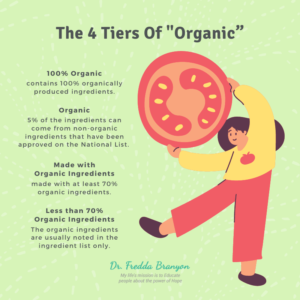
I find that most people do not realize there are different degrees of organic. I didn’t for a long time. If you are trying to buy healthy, did you know that if you are not careful, you can still be buying pesticides etc in a product labeled “organic”. Yes it’s true. How much more confusing can it get? However remember, educating ourselves is power and a part of preventive medicine.
The United States Department of Agriculture (USDA) has a set of standards that all organizations who are wanting to use the word “organic” must abide by. Recently the Federal Trade Commission (FTC) has adjusted the standard as to how manufacturers and food producers may claim a product to be organic.
I have included a breakdown of the different tiers of organic labeling to help you decide how you may want to shop and to understand what part of organic is really organic.
Products labeled as “100% Organic” can only contain 100% organically produced ingredients. According to the USDA’s national organic standard, manufactures and producers can display the USDA Organic logo.
To be labeled “Organic,” 5% of the ingredients can come from non-organic ingredients that have been approved on the National List. Ninety five percent should be real organic ingredients. These products can also display the USDA organic logo.
Products labeled with “Made with Organic Ingredients”must be made with at least 70 percent organic ingredients. Three of these ingredients must be labeled on the back of the package. The remaining 30 percent of the non-organic ingredients must be approved on the National List.
And then theres the “Less than 70 % Organic Ingredients”. The organic ingredients are usually noted in the ingredient list only.
So, what is on the National List? I decided to look it up and it really wasn’t that easy to find. Here is a website if you are interested from The National Archive And Records Administration. The “National List” is Title 7: Agriculture.
The following is a cute video you may enjoy about “What is Organic”.
Many treatments fall under the umbrella of Complementary and Alternative Medicine or CAM. Some of the most commonly used CAM therapies include: Acupuncture Chiropractic Food counseling Herbalism Massa...
For many centuries, Thanksgiving has been considered a national holiday in the U.S. and Canada to celebrate the harvest and other blessings of the preceding year. The traditions behind it have evolved...
Polls in the United States and Europe revealed that half the population are more afraid of cancer than any other disease. Cancer is, after all, a life-altering event that can trigger a rollercoaster o...