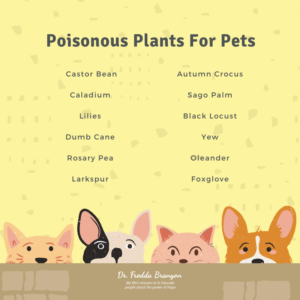
If your pet only sniffs certain plants, it could be deadly to them. Make sure that your home and yard is void of the presence of poisonous varieties of plants. Not only do they sniff them, but they also nibble on them. Ornamental houseplants can cause illness in your pet, up to and including death.
Would you believe that 150,000 calls have been made to the American Society for the Prevention of Cruelty to Animal’s (ASPCA) Poison Control hotline? About ¼ of these were non-drug related and due to plants. Pollen on a cat’s nose from lilies, or in their drinking water from a vase, can be deadly.
There are 12 specific plants that are poisonous, even though it is not an all-inclusive list. Symptoms can range from foaming at the mouth, vomiting, drooling, diarrhea, loss of appetite, organ failure and more.
The following are some of the most common plants that pose a poisoning risk to pets.
Castor Bean
Caladium
Lilies
Dumb Cane
Rosary Pea
Larkspur
Foxglove
Autumn Crocus
Sago Palm
Black Locust
Yew
Oleander
If your pet sniffs or eats a poisonous plant, contact your veterinarian immediately. Getting your pet prompt treatment may mean the difference between life and death. Seek medical attention anyway, if you aren’t sure if the plant is poisonous. Another option would be to contact the ASPCA’s database of toxic and non-toxic plants. You can also call their 24-hour emergency poison hotline at 1-888-426-4435 to get further information on what steps to take next.
Let’s all be very observant on the plants we are subjecting our loving pets to, and do our best to protect them from illness or possible death. After all, they are our family, right? For the seniors, many pets are considered their “children” now that their offspring have all grown and left home!
Many treatments fall under the umbrella of Complementary and Alternative Medicine or CAM. Some of the most commonly used CAM therapies include: Acupuncture Chiropractic Food counseling Herbalism Massa...
For many centuries, Thanksgiving has been considered a national holiday in the U.S. and Canada to celebrate the harvest and other blessings of the preceding year. The traditions behind it have evolved...
Polls in the United States and Europe revealed that half the population are more afraid of cancer than any other disease. Cancer is, after all, a life-altering event that can trigger a rollercoaster o...


 If your pet only sniffs certain plants, it could be deadly to them. Make sure that your home and yard is void of the presence of poisonous varieties of plants. Not only do they sniff them, but they also nibble on them. Ornamental houseplants can cause illness in your pet, up to and including death.